Most people choosing a promotional boomerang argue about the print first and the size last, which is backwards. Size decides how far the boomerang flies, how much space and skill a recipient needs to throw it, and whether it even comes back at all. A boomerang that is wrong for its audience becomes a wall decoration on day one, no matter how good the logo looks. Here is how the size classes actually differ, and how to pick the one your recipients will use.
Foam and indoor boomerangs: small, safe, forgiving
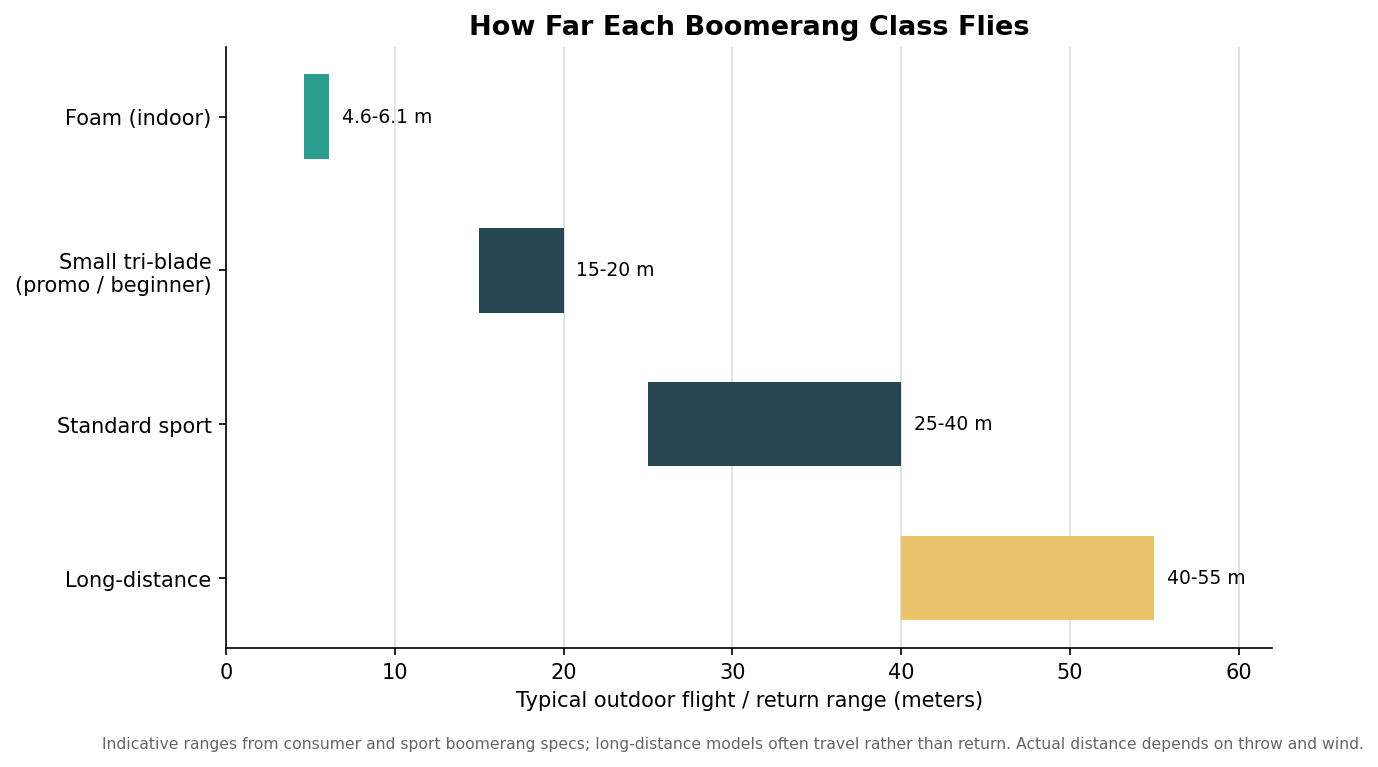
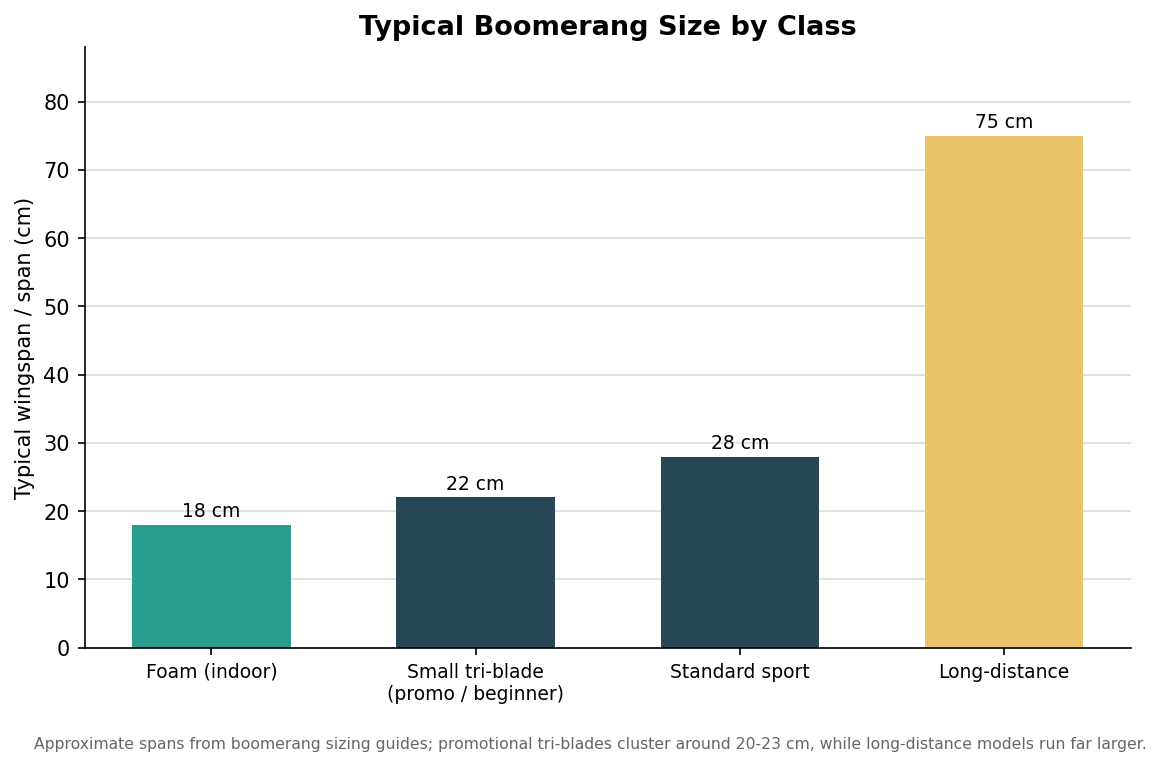
Foam boomerangs are the smallest and most forgiving class, usually spanning about 15 to 20 cm and weighing under 100 grams. That light, soft build is the whole appeal: they return in a short arc of roughly five to six meters, they are safe enough to throw in a gym or large room, and they need almost no wind. For a kids’ event, an indoor trade show booth, or any giveaway where recipients are as likely to be eight years old as forty, foam is the class that produces the most successful first throws and the fewest complaints.
The trade-off is that foam boomerangs feel like toys, because they are. If your brand wants the object to read as premium or to survive years of outdoor use, foam is not the material, but for sheer approachability nothing beats it.
Small tri-blade boomerangs: the promotional standard
The workhorse of promotional boomerangs is a small plastic tri-blade, typically around 20 to 23 cm across and 50 to 150 grams. The three-wing design is the reason this class dominates giveaways: it is markedly more stable and easier to throw for a return than a classic two-wing shape, which matters enormously when your recipients are beginners who will read the instructions once, if at all. Outdoors, a small tri-blade returns from roughly 15 to 20 meters, a distance that fits a park, a schoolyard, or a festival field without demanding a stadium.
This is also the class that prints well and ships cheaply at volume, so it is where most brands should start unless they have a specific reason to go larger. It hits the sweet spot of usable, safe, and affordable.
Standard sport and long-distance: more range, more demands
Step up to a standard sport boomerang, commonly 25 to 30 cm, and the return distance grows to roughly 25 to 40 meters, with tighter, faster flights that reward a practiced thrower. These are genuinely fun for enthusiasts, but they ask for more field, more skill, and more caution, which makes them a poor default for a mass giveaway and a good choice for a niche, sporty audience.
Long-distance boomerangs are a different animal entirely. At 60 to 90 cm and up to several hundred grams, many are built to travel rather than return, so handing one to a casual recipient sets them up to lose it or hurt someone. Reserve this class for collectors or serious throwers who asked for it specifically. For the vast majority of promotional programs, anything larger than a standard sport model is more liability than gift.
Wind and space: the specs nobody prints on the box
Two hidden requirements decide whether a boomerang is throwable at all, and both scale with size. The first is wind. The ideal condition is a light breeze, roughly Beaufort force one to two, the kind where you feel air on your face but leaves barely stir. Returning boomerangs can be thrown up to about force three or four, a moderate breeze that moves small branches, and only specialist wind models handle more. Too much wind and the boomerang sails away or slams back dangerously; too little and heavier models simply do not generate enough lift to complete the circle.
The second is clearance. A safe rule is to keep open space equal to about one and a half times the boomerang’s flight distance, so a model that returns from 30 meters wants roughly 45 meters of clear radius, free of people, cars, and windows. This is exactly why size and audience have to match: a long-range boomerang given to office workers with only a parking lot to use it in is not a gift they can safely enjoy.
Matching the size to your audience
Work backwards from who receives it and where they will throw it. For broad giveaways, family events, and indoor activations, foam or a small tri-blade will get thrown, returned, and remembered fondly, which is the entire point of a promotional item. For a sporty or outdoorsy audience with real open space, a standard sport model rewards the extra skill and feels like a more serious gift. And for a handful of enthusiasts or collectors, a long-distance piece can be a genuine prize, as long as you know that is who is receiving it.
One practical note for either handedness: boomerangs are made specifically for right-handed or left-handed throwers, and a right-handed model thrown left-handed will not return. If you cannot control who gets which, right-handed is the safer majority default, and clear throwing instructions on the packaging do more for satisfaction than any extra centimeter of wingspan. Treat the ranges and figures here as indicative starting points; the right size is simply the one your specific recipients can throw, in the space they actually have.
A simple ordering check: before you commit to a size, picture the single most common place your recipients will actually stand when they open the package. If that place is a living room, a booth aisle, or a small yard, size down to foam or a small tri-blade; if it is a real field, you have room to go larger. The space they have, not the range on the spec sheet, is what determines whether the boomerang gets thrown a second time.