Most people picture a boomerang as one shape: the classic V. In reality, the promotional boomerangs you can order come in three distinct configurations, and the one you pick decides how reliably a first-time thrower gets it back, how much of your logo the recipient actually sees, and how safe it is to hand out to a crowd of mixed ages. If you are choosing between designs for an event giveaway rather than a competition, the trade-offs are different from what a hobbyist would prioritize. Here is how the two-wing, tri-blade, and cross configurations compare on the things that matter for a branded handout.
Return ease is the whole point
A promotional boomerang only works as marketing if the person who catches it feels a small thrill when it comes back. That makes return reliability the first thing to weigh, and it is where the configurations genuinely differ. The general rule is that more wings make a boomerang easier to return. A traditional two-wing boomerang is the most authentic shape and the most satisfying to master, but it is also the least forgiving; it demands a reasonably correct grip, angle, and throw before it behaves. A tri-blade, with three wings arranged around a center, is far more tolerant of an imperfect throw and is the design most often recommended for beginners. A cross or four-blade design is the most forgiving of all, which is why lightweight four-wing models are so often the ones marketed as easy returners.
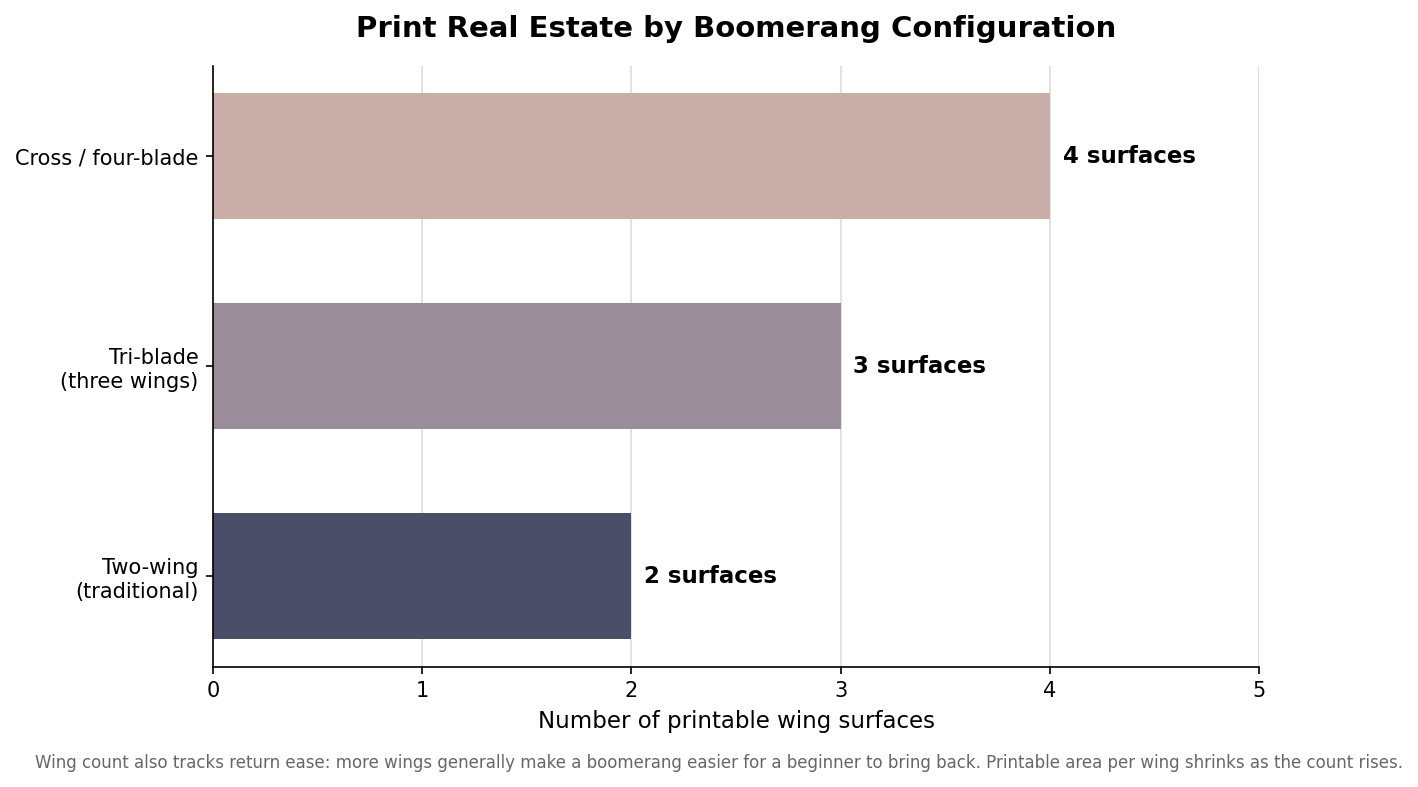
For a giveaway aimed at the general public, this ranking usually points away from the purist two-wing and toward the tri-blade as the sensible default. You are optimizing for the median attendee who has never thrown one, not for the one person at the booth who already competes. The chart below shows how wing count lines up with print area, and it doubles as a rough map of return ease.
How much of your brand people actually see
The reason you are printing a boomerang instead of a pen is the surface, and the configurations offer that surface differently. A two-wing boomerang gives you two long arms, which suits a wordmark or a single bold graphic that can stretch across a sweep. A tri-blade gives you three shorter panels radiating from the hub, which is well suited to a logo plus a tagline plus a URL, one message per blade. A cross gives you four panels but each is shorter still. More wings means more separate surfaces but less room on each one, so the right choice depends on whether your message is one big statement or several small ones.
There is a decorating angle here too. Flat, wide blades take print and engraving cleanly, and a tri-blade’s three even panels photograph well spinning in flight, which matters if part of the plan is people filming the giveaway. If your artwork is a detailed, full-color design, favor the configuration and size that give each panel enough width to hold it without shrinking the type below readable size.
Safety and your audience
Who is going to throw these should shape the decision as much as aesthetics. For events with children, the guidance is consistent: choose lightweight boomerangs in soft plastic or foam, keep the size small, and prioritize an easy, gentle return over range. Foam and light plastic models typically weigh under 100 grams, which keeps the energy low if a catch goes wrong, while plywood and hardwood models run heavier, roughly 150 to 300 grams, and fly with more authority than you want in a packed space.
The configuration interacts with this. A forgiving tri-blade or four-blade in a soft material lets a nervous first-timer succeed on a short, slow throw, which is exactly what you want in a festival field with bystanders around. Save the heavier hardwood two-wing pieces, which are lovely as keepsakes, for audiences who will throw them in genuinely open space. And whatever you choose, every promotional boomerang needs real room: an open area with a clear radius and no crowds downrange is non-negotiable, and it is worth printing a short throwing note or safety reminder alongside your brand.
Sizing and materials in practice
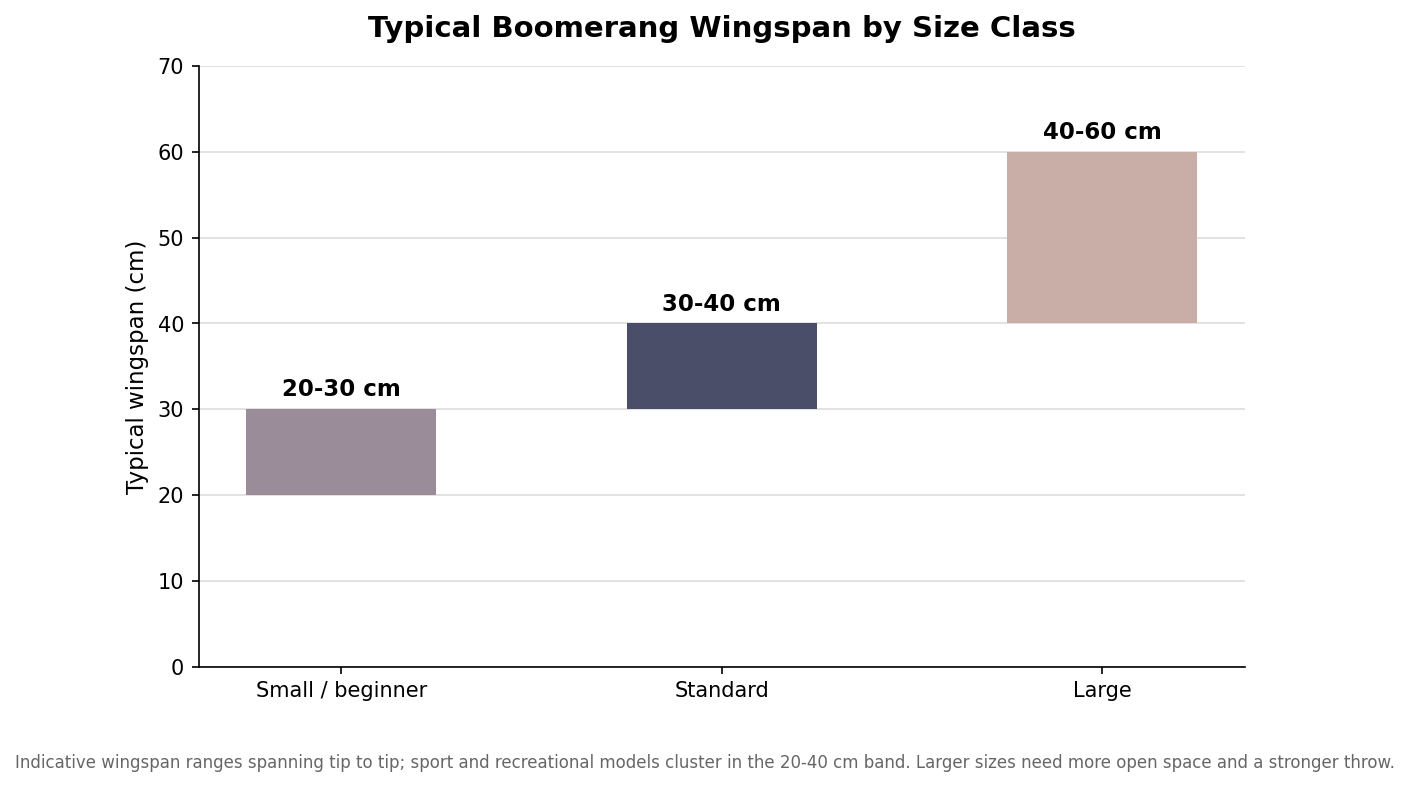
Size follows from audience and space. Sport and recreational boomerangs generally span from about 20 to 40 centimeters tip to tip, with beginner models clustering around the smaller end near 22 to 30 centimeters and larger models reaching 60 centimeters or more for experienced throwers with a big field. Smaller is usually better for a giveaway: it is cheaper to produce and ship, easier for a novice to control, and safer in a crowd. The chart below sketches the typical bands.
On materials, the practical menu is foam, plastic, plywood, and hardwood, in rising order of weight, durability, and cost. Light plastic and foam are the workhorses of the promotional world because they are inexpensive at volume, safe, and easy to return; plywood and solid wood move into premium keepsake territory and pair naturally with engraving. Match the material to the moment: a mass handout at an outdoor festival leans plastic, while a limited executive gift or an anniversary piece justifies engraved wood.
Choosing for your event
Put the pieces together and a clear default emerges for most brands. For a broad public giveaway where you want the highest share of attendees to experience the return, a small, lightweight tri-blade in plastic is hard to beat: forgiving to throw, three panels for your message, safe for mixed ages, and economical at volume. Step to a cross or four-blade if your crowd skews toward young children and ease trumps everything. Reserve the traditional two-wing, especially in wood, for audiences who value authenticity and have the space and patience to master it, or for keepsake pieces where the object matters more than instant success.
Whichever configuration you land on, decide it before you finalize artwork, because the number and shape of the panels dictate how your design is laid out. Get the configuration, size, and material right for the specific people who will throw them, and the boomerang does the one thing no flat handout can: it comes back, and so does the attention on your brand.